
Britannica
Sources used in this answer
Why are hydrogenated oils more solid at room temperature than vegetable oils?
Created from Britannica articles
using AI.
AI can make mistakes, so verify using Britannica articles.
Trans fat
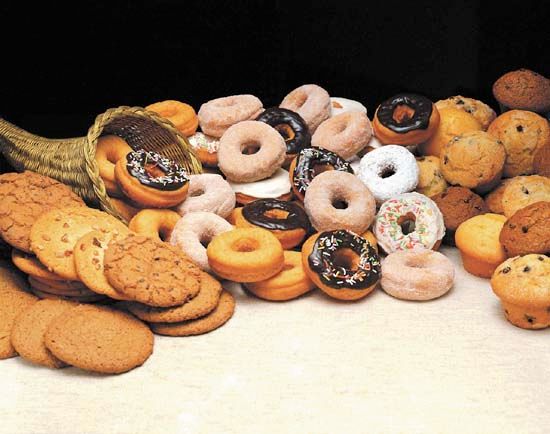
Commercially manufactured foods, including cookies, doughnuts, and muffins, often contain trans fats.
Vegetable oils are typically liquid at room temperature because they consist largely of unsaturated fatty acids, which contain double bonds that lower their melting points. In contrast, hydrogenated oils are more solid because the hydrogenation process chemically alters these fats to increase their stability and firmness.123
This transformation occurs through two primary mechanisms:
- Saturation: Hydrogen molecules are added to the points of unsaturation (the double bonds) in the fatty acid chains. By converting these double bonds into single bonds, the fatty acids become more saturated, which increases their melting point and makes the fat more solid and spreadable.12
- Isomerization: During the process, some unsaturated fatty acids are rearranged from their natural cis configuration to a trans configuration. Trans isomers have a linear structure that resembles saturated fat and possess significantly higher melting points than their natural cis counterparts, further contributing to the hardening of the oil.34
By manipulating these chemical structures, manufacturers can transform liquid vegetable oils into semisolid fats suitable for products like margarine and shortening.13