
Britannica
Sources used in this answer
How does pseudospin in graphene resemble particle spin?
Created from Britannica articles
using AI.
AI can make mistakes, so verify using Britannica articles.
graphene
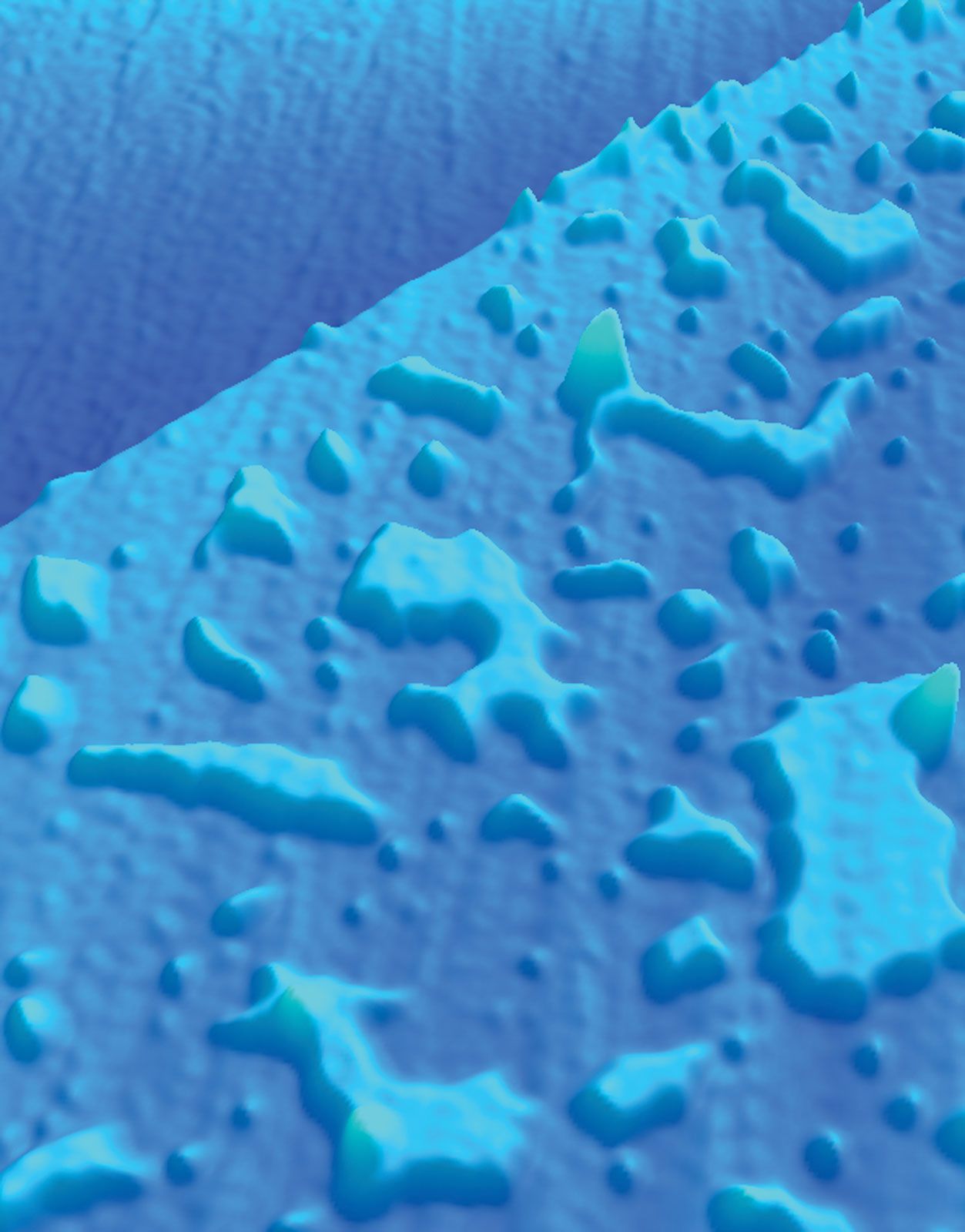
Atomic force microscopy image of water structures that were trapped beneath a sheet of graphene one atom thick.
In graphene, the honeycomb lattice is composed of two distinct sublattices, designated A and B. This specific geometrical arrangement grants electrons and holes an unusual degree of internal freedom known as pseudospin.1
Pseudospin resembles the spin—or internal angular momentum—of subatomic particles in the following ways:
- Functional Analogy: Just as particle spin represents an internal property of subatomic particles, pseudospin mimics this behavior within the graphene lattice.1
- Particle-Antiparticle Correspondence: Within this framework, electrons and holes in graphene function analogously to particles and antiparticles (such as electrons and positrons) in quantum electrodynamics.1
- Relativistic Simulation: Because the charge carriers in graphene behave like ultra-relativistic quantum particles, pseudospin allows graphene to serve as a test bed for high-energy physics. It enables the study of quantum relativistic effects that are otherwise difficult to observe in traditional particle experiments.1