
Britannica
Sources used in this answer
How does HDL cholesterol help remove cholesterol from blood vessels?
Created from Britannica articles
using AI.
AI can make mistakes, so verify using Britannica articles.
Trans fat
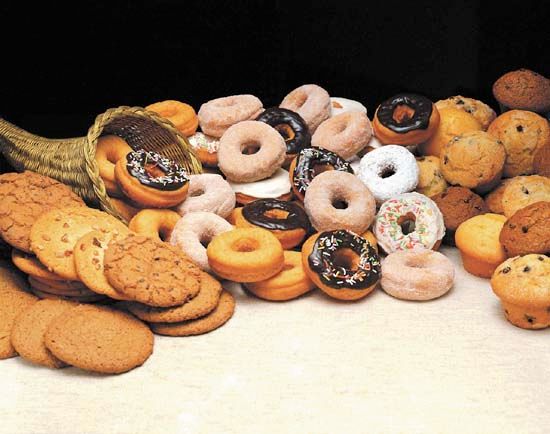
Commercially manufactured foods, including cookies, doughnuts, and muffins, often contain trans fats.
High-density lipoproteins (HDL), often referred to as "good cholesterol," help remove excess or unused cholesterol from the body's tissues and blood vessels.12
The process functions as follows:
- Collection: HDL particles, which are initially secreted by the liver as small, flattened discs, travel to peripheral tissues where they pick up cholesterol from the surface membranes of cells.3
- Conversion: Through the action of an enzyme called lecithin cholesterol acyltransferase (LCAT), which is activated by the apoprotein A-I found on HDL, the collected cholesterol is converted into esters.3
- Transport and Excretion: Once loaded, HDL transports this cholesterol back to the liver. There, it is broken down into bile acids and salts, which are then excreted from the body.23
By facilitating this reverse transport, HDL helps retard or reduce the buildup of atherosclerotic deposits in the blood vessels, which are primarily associated with low-density lipoproteins (LDL).2