
Britannica
Sources used in this answer
How do herbivore teeth help animals grind plant material?
Created from Britannica articles
using AI.
AI can make mistakes, so verify using Britannica articles.
Feeding behaviour
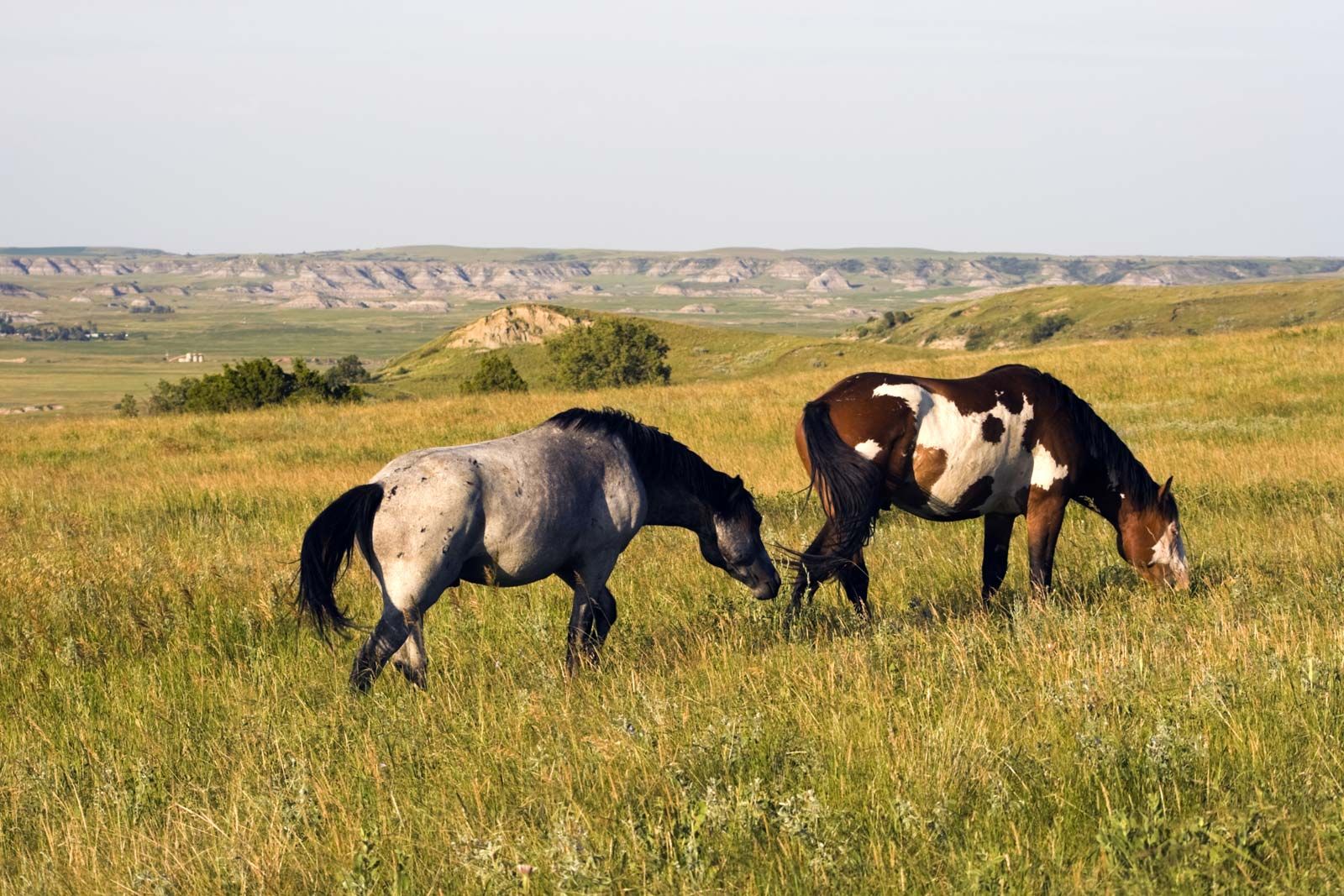
Wild horses graze in the Badlands of North Dakota.
Herbivores have evolved specialized dental adaptations to effectively process plant material, which is often tough and fibrous. Because plant cell walls are primarily composed of cellulose—a material that digestive enzymes cannot easily break down—mechanical reduction through chewing is essential to expose the plant's nutrients to digestive processes.12
Key dental adaptations for grinding include:
- Molarization of Premolars: Many herbivores exhibit the expansion and flattening of premolars, which increases the surface area available for grinding food.3
- Complex Cheek Teeth: Herbivores possess specialized cheek teeth with complex patterns of contact (occlusion) designed to crush and grind tough vegetation.3
- Continuous Growth: To circumvent the problem of excessive wear caused by grinding abrasive plant material, some herbivores have evolved rootless incisors or cheek teeth with open pulp cavities, allowing for continual growth throughout the animal's life.3
- Diastema: Many herbivores have lost certain teeth, resulting in a gap known as a diastema in the tooth row, which facilitates the manipulation of food.3
These adaptations allow herbivores to break down tough vegetable fibers into smaller particles, facilitating easier swallowing and more efficient digestion.2