
Britannica
Sources used in this answer
How are trans fats different from saturated fats?
Created from Britannica articles
using AI.
AI can make mistakes, so verify using Britannica articles.
Trans fat
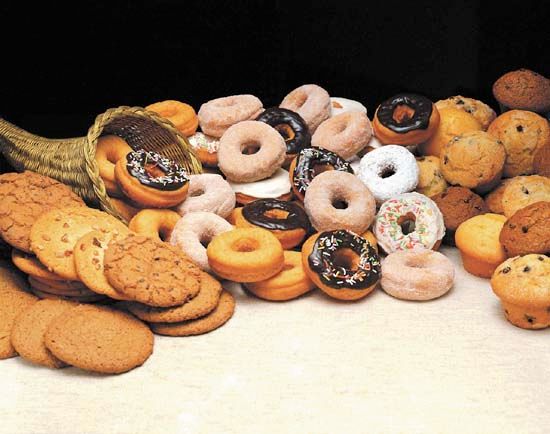
Commercially manufactured foods, including cookies, doughnuts, and muffins, often contain trans fats.
Trans fats and saturated fats differ primarily in their chemical structure and their specific effects on cholesterol levels.
Chemical Structure
- Saturated Fats: These consist of hydrocarbon chains containing only single bonds between carbon atoms. This structure allows them to pack closely together, typically resulting in a solid state at room temperature.1
- Trans Fats: These are a type of unsaturated fat. While natural unsaturated fats (cis-configuration) have a "v" shape due to double bonds, the industrial process of hydrogenation creates a "trans" configuration. This process forces a twist in the molecule, making it linear and structurally similar to saturated fat, which allows it to remain solid at room temperature.23
Health Impact
Both types of fat are linked to cardiovascular risks, but trans fats are often considered more harmful:34
* Saturated Fats: Primarily elevate levels of "bad" LDL cholesterol.4
* Trans Fats: These pack a "double whammy" by raising LDL cholesterol while simultaneously reducing "good" HDL cholesterol, which is protective against heart disease.32
While some trans fats occur naturally in ruminant products, the primary concern involves those produced industrially for use in processed and fried foods.32