Belém
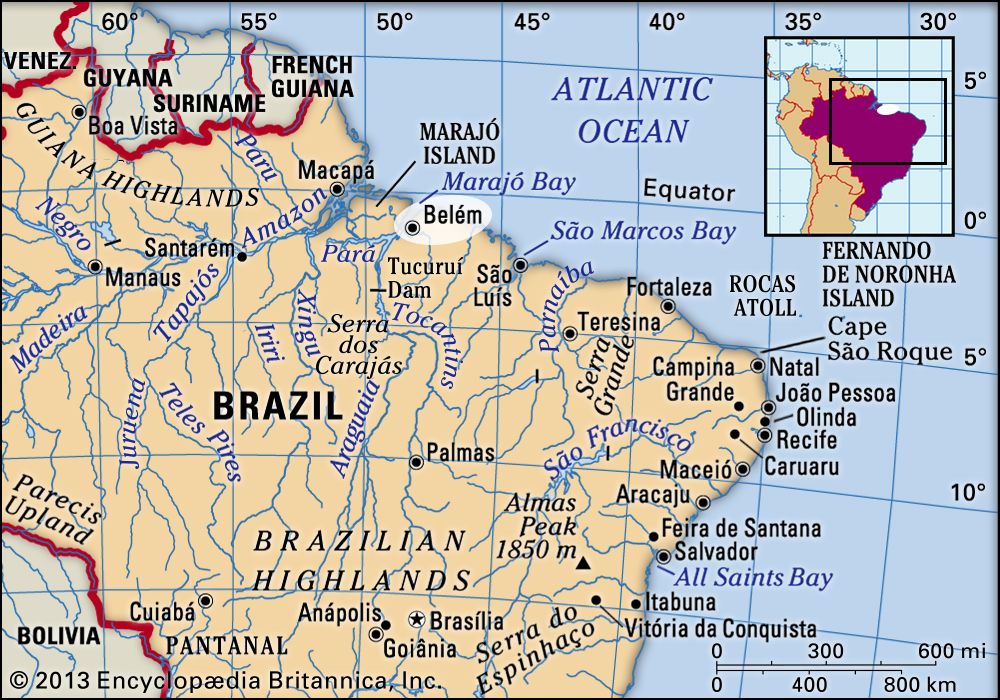
Belém, city and port, capital of Pará estado (state), northern Brazil. It is situated on Guajará Bay, part of the vast Amazon River delta, near the mouth of the Guamá River, about 80 miles (130 km) up the Pará River from the Atlantic Ocean. Its climate is equatorial, with an average annual temperature of 80 °F (27 °C) and an annual rainfall of 86 inches (2,175 mm).
In 1616 the fortified settlement of Feliz Lusitânia, later called Nossa Senhora de Belém do Grão Pará (Our Lady of Bethlehem of the Great Para River) and Santa Maria de Belém (St. Mary of Bethlehem), was established, consolidating Portuguese supremacy over the French in what is now northern Brazil. Belém was given city status in 1655 and was made the state capital when Pará state was separated from Maranhão in 1772. The early decades of the 19th century were marked by political instability. Uprisings and internecine strife were finally ended in 1836, after considerable loss of life.
The sugar trade was important in the Belém region until the end of the 17th century. Thereafter the city’s economic importance alternately rose and fell. Cattle ranching supplanted sugar until the 18th century, when cultivation of rice, cotton, and coffee became profitable. With the settlement of southern Brazil, where such crops could be produced more reasonably, Belém declined again. The city subsequently became the main exporting centre of the Amazon rubber industry, and by 1866 its position was further enhanced by the opening of the Amazon, Tocantins, and Tapajós rivers to navigation. The rubber era terminated after the boom of 1910–12, but Belém continued to be the main commercial centre of northern Brazil and the entrepôt for the Amazon basin.
The most valuable products now exported from the Amazon by way of Belém are aluminum, iron ore, and other metals, nuts (chiefly Brazil nuts), pineapples, cassava, jute, wood veneers, and hardwoods. Japanese immigration after the 1930s was an important factor in developing jute and black pepper, notably at Tomé-Açu, just south of Belém, and near Santarém. Marajó Island, the largest fluvial island in the world, which lies just across the Pará River from Belém, has some livestock grazing. Electricity is provided by the massive Tucuruí Dam, some 200 miles (300 km) southwest of the city on the Tocantins River.
The north’s leading educational and cultural centre, Belém has a modern appearance with tree-lined streets, several plazas and public gardens, and many noteworthy buildings. It is the seat of a bishopric, and its cathedral (Igreja da Sé, founded in 1917) is one of Brazil’s largest. Santo Alexandre, the oldest of Belém’s churches, was built in 1616. The Museu (museum) Paraense Emílio Goeldi, the Teatro da Paz (a classical theatre), and the public library and archives are notable institutions. The Universidade Federal do Pará (1957), a teacher-training school, an agricultural institute, and an institute for research on tropical diseases are also in the city. The Ver-o-Peso (Portuguese: “See the Weight”) market in the old port centre is a major tourist attraction. The city is home to a large football (soccer) stadium.
Belém is the host of the annual Círio de Nazaré, one of the world’s largest celebrations honouring the Virgin Mary, who, as the Virgin of Nazaré, is the patron saint of Pará. The highlight of the 15-day festival occurs on the second Sunday of October, when the city welcomes more than one million pilgrims who come to participate in a procession that follows an image of the Virgin of Nazaré throughout Belém.
Belém is the main port for Amazon River craft and is served by international and coastal shipping and by inland vessels south to Brasília, some 1,275 miles (2,050 km) away. Paved roads extend to Piauí and Goiás states. A railway leads 145 miles (233 km) east-northeast to Bragança. Belém’s international airport is northern Brazil’s largest. Pop. (2010) 1,393,399.