Masjed-e Emām
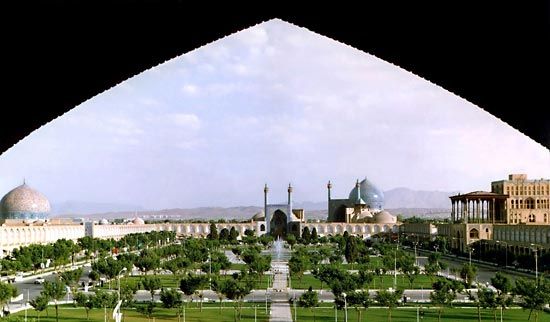
Eṣfahān, Iran: Maydān-e EmāmThe Maydān-e Emām (formerly the Maydān-e Shāh), originally built as a polo ground by Shāh ʿAbbās I the Great (reigned 1588–1629), at Eṣfahān, Iran. Facing the square on the left is the mosque of Shaykh Luṭf Allāh (Sheikh Lotfollāh), in the centre is the Masjed-e Emām (formerly the Masjed-e Shāh), and at right is the palace of ʿAlī Qāpū.
Masjed-e Emām, celebrated 17th-century mosque in Eṣfahān, Iran. The mosque, part of the rebuilding effort of the Safavid shah ʿAbbās I, was located at the centre of Eṣfahān, along a great central mall (city square or courtyard) called the Maydān-e Emām (since 1979 a World Heritage site). Along with the three neighbouring structures of the period, the Masjed-e Emām is notable for its logically precise vaulting and inventive use of coloured tiles. The mosque was renamed after the Iranian Revolution of 1979.
The Editors of Encyclopaedia Britannica This article was most recently revised and updated by Adam Zeidan.
Citation Information
Article Title:
Masjed-e Emām
Website Name:
Encyclopaedia Britannica
Publisher:
Encyclopaedia Britannica, Inc.
Date Published:
22 June 2021
Access Date:
November 13, 2026