Fallingwater
Fallingwater, weekend residence near Mill Run, southwestern Pennsylvania, that was designed by American architect Frank Lloyd Wright for the Kaufmann family in 1935 and completed in 1937. The house’s daring construction over a waterfall was instrumental in reviving Wright’s architecture career and became one of the most famous 20th-century buildings. The residence opened as a museum in 1964.
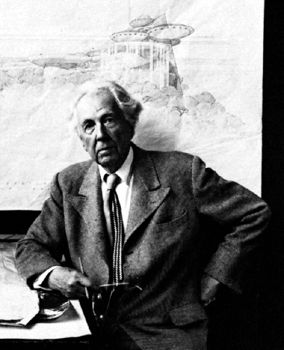
Edgar J. Kaufmann, Sr., a department store magnate, and his wife, Liliane, commissioned Wright to design a weekend retreat on the family’s land near the former Bear Run community southeast of Pittsburgh. Kaufmann had been introduced to Wright by his son, Edgar, in 1934, when the latter participated in Wright’s Taliesin Fellowship, a training program for architects and artists. Wright was 67 at the time of the meeting, with few commissions in the midst of the Great Depression. His career was seemingly near retirement—the early success of his Prairie style residences in the first decade of the 1900s had abated following the negative publicity of his personal life. Wright’s design for Fallingwater, however, proved that he still maintained a bold vision for architecture. Kaufmann and his wife expected a weekend house that would offer views of a favourite waterfall, but they were startled to find that Wright’s plans situated the house directly above the waterfall. Wright argued that he did not want to relegate the falls to a mere view on which the Kaufmanns might occasionally look from afar, but that he wanted to bring the falls to the family’s everyday life. By situating the residence over the waterfall, the Kaufmanns would always be able to hear the movement of the water and be aware of the waterfall’s presence.
After some doubts and heated arguments, construction of Fallingwater began in 1936. Local craftsmen and labourers were hired, and materials were directly excavated from the Kaufmanns’ land. Fallingwater was mainly complete in 1937, with the family occupying the residence that fall. It quickly gained fame when Time magazine featured Wright and a drawing of the building on the cover of its January 17, 1938, issue. Indeed, Wright added a guest house to the site in 1939 to accommodate the Kaufmanns’ curious visitors.

Fallingwater was a masterpiece of Wright’s theories on organic architecture, which sought to integrate humans, architecture, and nature together so that each one would be improved by the relationship. Wright believed that architecture must not only sit comfortably within its natural landscape, replicate its forms, and use its materials, but must also cultivate and reveal the dormant qualities hidden within its setting. Fallingwater accordingly grows from the site’s rocky landscape. Its concrete terraces float above the falls, drawing attention to the water while respecting its space. Their horizontal forms and ochre colour recall and highlight the boulders below. Although the terraces appear to hover, they are in fact anchored to the house’s central stone chimney using cantilevers. Wright’s houses typically expand from a central fireplace, which he believed was the focal point of any home. Wright intended the circulation of the building to have a sense of compression when indoors and of expansion when approaching the outdoors. Hence the expansive terraces occupy about half of the building, while the interior spaces are small with low ceilings, creating a sheltered cave amid the rugged landscape. The building draws nature inside its three floors: natural cliffs protrude from the central fireplace, southern light enters through expansive corner windows, and the sound of rushing water is always present. Wright’s careful attention to detail offered such unique features as a hatch on the first floor over stairs leading directly to the streambed below, customized niches to display the Kaufmanns’ art collection, and built-in furniture to complement the space.
Fallingwater proved that Wright was not an outdated architect ready for retirement but an enduring visionary ready for the next phase of his career. Some of his most high-profile commissions came after, including the Guggenheim Museum in New York City. The Kaufmanns continued to reside in Fallingwater but quickly noticed that the main terrace was beginning to sag, later recognized as the result of Wright’s refusal to use additional steel despite his contractor’s suggestions. The terrace was repaired decades later by adding steel cables.
Years after his parents’ deaths in the 1950s, Edgar Kaufmann, acting on his father’s wishes, entrusted the building and nearby land to the Western Pennsylvania Conservancy in 1963. Fallingwater opened as a museum the following year, with the Kaufmanns’ thoughtfully selected furniture and curated art collection intact. The conservancy continued to maintain the building into the 21st century, welcoming about 150,000 visitors per year. In 2019 the residence, along with seven other Frank Lloyd Wright buildings, was designated a UNESCO World Heritage site.