
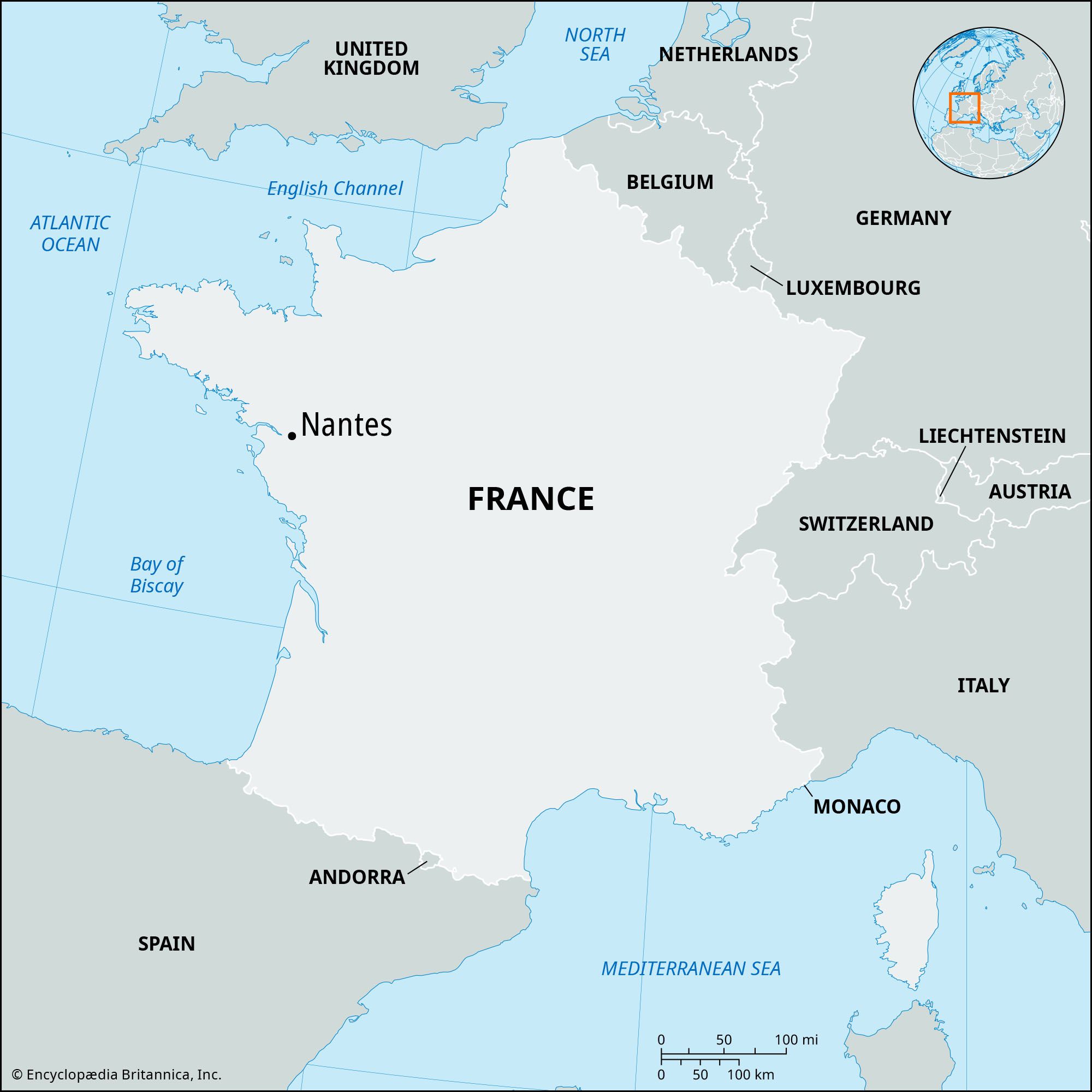



Nantes
News •
-
Where is Nantes located in France?
Nantes is a city in western France, situated at the head of the Loire River estuary where it meets the Erdre and Sèvre rivers, 35 miles (56 km) from the sea and southwest of Paris. It is the capital of the Loire-Atlantique département, in the Pays de la Loire région. Nantes has evolved significantly in the 20th and 21st centuries and become a dynamic regional center with a diversified economy.
2 Britannica SourcesCreated from Britannica articles using AI. AI can make mistakes, so verify using Britannica articles. -
What is Nantes known for?
Nantes is a city in western France, situated where the Loire River meets the Erdre and Sèvre rivers. It is known for its history, dynamic regional center, and cultural attractions.
Nantes has undergone significant transformations, especially after partial destruction during World War II, and was designated as one of eight provincial counterweights to Paris in the 1960s. The city has a diversified economy that includes food processing, engineering, biotechnology, and aeronautical components. Nantes also has a large scientific park and many regional headquarters for industrial and service firms.
Points of interest include the Nantes Cathedral, which has Gothic architecture, and the medieval castle rebuilt in 1466. The Musée des Beaux-Arts houses varied painting collections.
2 Britannica SourcesCreated from Britannica articles using AI. AI can make mistakes, so verify using Britannica articles. -
How is the river Loire important to Nantes?
Nantes is located on the Loire River, about 35 miles (56 km) from the Atlantic Ocean. The Loire River is essential to Nantes because the city sits at the head of the river's estuary, where it meets the Erdre and Sèvre rivers. Nantes became a commercial center because of its location on the Loire. The Loire was once a great highway for goods, making cities on its banks busy ports.
2 Britannica SourcesCreated from Britannica articles using AI. AI can make mistakes, so verify using Britannica articles. -
What is the historical significance of Nantes as a port city?
Nantes holds historical significance as a port city due to its location at the head of the Loire River estuary. It became a commercial center during Roman times. Despite being pillaged by the Normans, Nantes grew into a major port. In 1598, Henry IV signed the Edict of Nantes there, granting civil liberties to Protestants. While the city suffered during the French Revolution and was occupied by the Germans in World War II, it has since become a dynamic regional center with a diversified economy. Today, Nantes stands as one of France's most transformed cities, blending its historical importance with modern growth.
2 Britannica SourcesCreated from Britannica articles using AI. AI can make mistakes, so verify using Britannica articles. -
Who was Jules Verne and what connection does he have to Nantes?
Jules Verne (1828–1905) was a prolific French author, born in Nantes, whose writings laid much of the foundation of modern science fiction. His father intended for him to be an attorney, but Verne fell in love with literature and began writing plays and short stories. In 1862, Verne met Pierre-Jules Hetzel, who published Verne’s Cinq semaines en ballon (Five Weeks in a Balloon). The novel became an international bestseller, and Verne secured a long-term contract with Hetzel, leading to over 60 works in the Voyages extraordinaires series.
1 Britannica SourceCreated from Britannica articles using AI. AI can make mistakes, so verify using Britannica articles. -
How has Nantes changed from its past to the present in terms of economy and culture?
Nantes has undergone significant transformations in the 20th and 21st centuries. Once the capital of the Gallic tribe, Namnètes, and later a commercial center under the Romans, Nantes faced pillaging by the Normans and religious conflicts during the Wars of Religion.
Designated as a counterweight to Paris in the 1960s, Nantes has become a dynamic regional center with a diversified economy. While traditional industries like food processing and engineering remain, biotechnology has seen recent growth, supported by a large scientific park. Nantes is also a major business center, attracting firms relocating from Paris, and has a large higher education sector, with a university founded in 1961. The redevelopment of docklands and specialized conference facilities has stimulated tourism.
1 Britannica SourceCreated from Britannica articles using AI. AI can make mistakes, so verify using Britannica articles.
Nantes, city, Loire-Atlantique département, Pays de la Loire région, western France. Nantes is situated at the head of the estuary of the Loire River, where it is joined by the Erdre and the Sèvre rivers, 35 miles (56 km) from the sea and southwest of Paris. It is one of the French towns that has changed the most in the 20th and 21st centuries.
Nantes derives its name from the Namnètes, a Gallic tribe who made it their capital. It became a commercial centre under the Romans. The Normans, after pillaging the town, occupied it from 834 to 936. After a long struggle in the Middle Ages between the counts of Nantes and Rennes for the sovereignty of Brittany, in 1560, Francis II, king of France (1559–60), granted Nantes a communal constitution. During the Wars of Religion (1562–98), Nantes joined the Catholic League and only opened its gates to Henry IV, king of France (1589–1610), in 1598, the same year he signed the Edict of Nantes, a charter assuring religious and civil liberties to the Protestants. During the French Revolution, Nantes suffered the ruthless repression of an envoy of the revolutionary Committee of Public Safety named Jean-Baptiste Carrier. In 1793 Carrier replaced executions by the guillotine, which he considered too slow, with mass drownings. The city was occupied by the Germans during World War II.
Greatly modified by an urban renewal plan that was adopted in 1920, Nantes was further altered and extended after having been partly destroyed in World War II. In the 1960s Nantes was designated as one of the eight provincial counterweights to reduce the dominance of Paris on French national life. It has become a dynamic regional centre, with a diversified economic structure. Traditional industries such as food processing, engineering, and the manufacture of components for the aeronautical industry remain important, but recent growth has occurred in fields such as biotechnology. A large scientific park, created in 1987, was designed to foster these activities. Nantes is also a major business centre and is the home of many regional headquarters of both industrial and services firms. A number of public and private sector offices have relocated from Paris to the city. Nantes has a large higher education section. The original university (founded 1460) was abolished during the French Revolution, but a new one was established in 1961. Tourism has been stimulated by redevelopment of part of the former docklands and the building of specialized conference facilities.




Although the cathedral of Saint-Pierre was built between the 15th and 20th centuries, it retains a Gothic unity. The imposing facade (1434–1508) has three finely sculptured doorways and two high towers. The cathedral, bombed during World War II, had been nearly completely restored in 1972 when a fire largely destroyed the roof. The magnificent Renaissance tomb of Francis II, duke of Brittany (ruled 1458–88), was luckily unharmed. The medieval castle had been rebuilt in 1466 by this same Francis II. Viewed from without, it looks like a fort with crenellated towers, but the inner courtyard is a typical Renaissance palace. The Musée des Beaux-Arts has one of the most important and varied collections of paintings in France. Pop. (1999) 261,576; (2014 est.) 298,029.