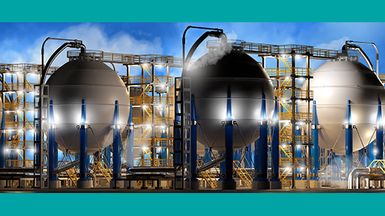
Investors are taking new interest in liquefied natural gas.
© Grispb/stock.adobe.com
Liquefied natural gas, or LNG, has transformed natural gas from a regional to a global commodity. With that shift, investment in LNG stocks has surged.
Natural gas, which is primarily methane, is most often transported in its gaseous form by pipeline, which has previously limited distribution to three major basins in the Americas, Europe, and Asia. But chilling natural gas to below −162 °C (−259 °F) forms the molecules into a liquid that’s up to 600 times smaller than the gas, making it much easier to transport by ship and linking far-flung locales to an energy source crucial to the global transition away from coal.
This shift has altered the market and investing landscape, reshaping how the LNG industry operates—from gas fields to pipelines—and changing what drives investor returns.
Key Points
- LNG turns natural gas into a global commodity by enabling transport across oceans via specialized tankers.
- The U.S., Qatar, and Australia dominate LNG exports, with Europe and Asia as major buyers.
- Investors can access LNG exposure through individual energy companies or broader oil and gas ETFs and mutual funds.
The first commercial shipment of LNG occurred in the 1960s with a cargo from the United States to the United Kingdom. From the 1970s to the 1990s, global LNG infrastructure grew, with Qatar emerging as a major supplier and Japan, South Korea, and France building import terminals.
By the early 21st century, LNG production, storage, and transportation had become more economical—just in time for the shale gas revolution in the U.S. The country sits atop some of the world’s biggest proven reserves of natural gas, as technological advancements in horizontal drilling and hydraulic fracturing (“fracking”) opened up more of the commodity trapped in shale formations.
The increase in production helped the U.S. swing from a net importer of natural gas to a net exporter as of 2017. The country ranks as one of the biggest natural gas exporters in the world, largely helped by its position as the biggest LNG exporter (see figure 1).
Figure 1: FROM NET IMPORTER TO NET EXPORTER. The U.S. holds some of the world’s biggest proven reserves of natural gas and has become the largest exporter of LNG.
Encyclopædia Britannica, Inc.
Because natural gas is so abundant and easily produced in the United States, it has become much cheaper than natural gas produced in Europe or Asia, making it economical to convert gas into LNG and ship it to those markets. Exports from the U.S., Australia, and Qatar—the three largest exporters as of 2025—made up 60% of global exports, with Europe and Asia being two important import markets.
Europe became a more prominent LNG importer after the 2022 Russian invasion of Ukraine disrupted pipeline gas flows and prompted a reassessment of energy security. In 2021, the European Union imported more than 40% of its piped natural gas from Russia, but significantly reduced its dependency by expanding LNG import capacity and diversifying its supplier base.
By 2024, U.S. LNG accounted for 46% of Europe’s LNG imports, the largest single source.
Asia has long been a cornerstone of LNG demand; in 2024, 33% of U.S. exports of LNG went there. Japan and South Korea are among the largest importers, using LNG to fuel power generation and manufacturing. China and India have also emerged as top importers. Asia’s growing population, rapid industrialization, and need to transition away from coal continue to make it a key region for future demand growth.
LNG infrastructure
Liquefaction facilities
After natural gas is extracted from the ground, it’s moved through a vast array of pipes and processing plants and eventually to power plants and homes—and facilities that turn it into liquefied natural gas. These facilities use “liquefaction trains” made up of heat exchangers, compressors, and power sources such as gas or steam turbines to chill gas into liquid. The more trains a plant has, the more LNG it can produce.
Liquefaction plants are typically located near ports so the LNG can be easily loaded onto specialized tankers. As of 2025, there are more than 700 LNG carriers plying the world’s oceans; they have to keep the liquid at very low temperatures, under very high pressure, or both. To do this, vessels are equipped with heavy insulation and temperature-controlled tanks, which often give them a distinctive look with multiple domes rising above the deck (see video).
Overview of tankers carrying liquefied natural gas (LNG).
Contunico © ZDF Studios GmbH, Mainz; Thumbnail © LittleAdventures/Dreamstime.com
The tankers can range in size from small-scale vessels with 35,300 cubic feet of cargo capacity to large carriers with more than 9.2 million cubic feet of capacity.
Regasification facilities
Before LNG can be used for generating electricity, cooking, heating homes, or industrial processes, it must be turned back into a gaseous form.
Special facilities, also typically located at ports, use steam, hot water, or air-warmed pipes to convert LNG back into gas for pipeline distribution.
For investors looking for exposure to the growing LNG industry, there are public companies involved in many aspects of the supply chain. If you’d like segmented LNG exposure, but you don’t want to limit it to a specific company, there are several exchange-traded funds (ETFs) and mutual funds to choose from.
Large oil and gas companies such as Royal Dutch Shell (SHEL), Chevron (CVX), ExxonMobil (XOM), and TotalEnergies (TTE) are involved in nearly every part of the LNG process. Smaller players, such as Cheniere Energy (LNG) and Venture Global (VG), can offer more concentrated exposure to LNG, but can also be riskier than the big diversified oil and gas majors.
Though large oil and gas companies often operate LNG vessels as part of their broader operations, some smaller companies concentrate more specifically on LNG transport and floating infrastructure. Flex LNG (FLNG) and Dynagas LNG Partners (DLNG) offer LNG shipping services, while Golar (GLNG) operates floating liquefaction and regasification facilities.
Other types of companies that stand to benefit from increasing LNG demand include those that own and operate pipelines to transport gas to and from LNG infrastructure, such as Enbridge (ENBR) and Kinder Morgan (KMI); explorers and producers that extract natural gas from the ground, such as Expand Energy (EXE) and Occidental (OXY); and petroleum industry service companies, such as Halliburton (HAL) and Schlumberger (SLB).
For diversified exposure to the LNG and broader natural gas sectors—or if you’re interested in exposure to the price of natural gas—investors may consider exchange-traded funds (ETFs) and mutual funds, such as these larger ones:
- United States Natural Gas Fund (UNG). Rather than track companies in the sector, UNG is an ETF that invests in natural gas futures markets to target the performance of natural gas price fluctuations.
- First Trust Natural Gas ETF (FCG). This ETF focuses on companies engaged in the exploration and production of natural gas.
- iShares U.S. Oil & Gas Exploration & Production ETF (IEO). IEO tracks an index of U.S. companies that are primarily engaged in the exploration and production of oil and natural gas, including several firms with significant LNG operations.
- Hennessy Gas Utility Fund (GASFX). This mutual fund invests in companies involved in the distribution of natural gas, aiming to capitalize on the growing demand for cleaner energy sources.
- Fidelity Select Natural Gas Portfolio (FSNGX). This mutual fund targets firms primarily engaged in natural gas production and services.
- Guinness Atkinson Global Energy Fund (GAGEX). For investors looking beyond U.S. markets, this fund offers broad international exposure to energy companies, including those in the LNG sector.
The bottom line
The investing outlook for LNG seems promising given the expected electrification of industries like transportation, plus technology’s growing reliance on energy-intensive artificial intelligence data centers.
Meanwhile, many countries around the world are seeking to reduce their use of coal for power generation, with natural gas expected to serve as a transitional fuel until lower-emission sources such as wind, solar, and nuclear power become more widely available.
Specific companies and funds are mentioned in this article for educational purposes only and not as an endorsement.
This article was most recently revised and updated by Matt WhittakerThis article was most recently revised and updated by Doug Ashburn