Encyclopaedia Britannica's editors oversee subject areas in which they have extensive knowledge, whether from years of experience gained by working on that content or via study for an advanced degree. They write new content and verify and edit content received from contributors.
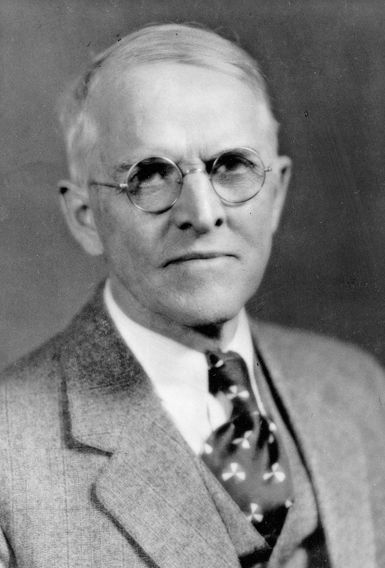
Wesley C. Mitchellwas an American economist, the world’s foremost authority of his day on business cycles.
Mitchell was educated at the University of Chicago, where he came under the influence of Thorstein Veblen and John Dewey. He taught at numerous universities, including the University of Chicago (1900–02), the University of California (1902–12), Columbia University (1913–19; 1922–44), and the New School for Social Research, New York City (1919–21). Despite his extensive teaching, Mitchell was primarily devoted to economic research.
In 1920 he helped to organize the National Bureau of Economic Research and was its director of research until 1945. He served as chief of the price section of the War Industries Board during World War I, as chairman of President Herbert Hoover’s Research Committee on Social Trends, and as a member of the National Planning Board (1933) and of the National Resources Board (1934–35). Under Mitchell’s leadership, the Social Science Research Council, of which he was chairman (1927–30), and the Bureau of Educational Experiments greatly influenced the development of quantitative studies of economic behaviour in the United States and abroad.
Among his publications are Business Cycles (1913), Business Cycles: The Problem and Its Setting (1927), The Backward Art of Spending Money (1937), and Measuring Business Cycles (1946), written with A.F. Burns.