


- Related Topics:
- cemetery

9 Cemeteries to Die For
Though it makes us wince to say so, we are all mortal. We may not have William Shakespeare’s sense of humor about that (as, for example, when he has the fatally wounded Mercutio say “Ask for me tomorrow, and you shall find me a grave man”), but we know, intellectually anyhow, that eventually death takes us all. In spite of that personal affront, there is something about cemeteries that is irresistible. Perhaps you collect felicitous graveyard epitaphs (“I told you I was sick!” or “If you can read this, you’re standing too close”) or maybe you make pilgrimages to the final resting places of artists or writers you revere. There are many reasons to track down a good cemetery. It’s usually some combination of philosophy, landscape, and history that draws us in. Here are a few favorites.
West 11th Street Cemetery, Greenwich Village, New York City
Here’s a tiny, delightful spot, discoverable on any literary walking tour of Greenwich Village. It’s just a short distance from the charming Patchin Place, off 10th Street between Greenwich and Sixth avenues, once home to such writers as Djuna Barnes, Jane Bowles, E.E. Cummings, and Theodore Dreiser. The West 11th Street Cemetery is a minuscule wedge of land at 76 W. 11th Street. It is the second cemetery of three belonging to Congregation Shearith Israel (established 1654), the first Jewish congregation in North America. There isn’t really a lot to see there—an obelisk, two table gravestones, and several upright stones, most of which are illegible. But oh the history! The first members of the congregation were Spanish and Portuguese Jews who, expelled from their homelands in the mid-16th century, had come to North America by way of Recife, Brazil, which they fled when the Portuguese had wrested control of Recife from the Dutch. New Amsterdam’s governor, Peter Stuyvesant, though himself Dutch, was not so welcoming, but happily they prevailed. When in 1805 the congregation outgrew the first cemetery, they founded the second, only a corner of which remains. Related sites worth a visit: Chatham Square Cemetery (at 55 St. James Place in Chinatown, the first burial ground of Shearith Israel) and the African Burial Ground National Monument (at 290 Broadway).
Newville Cemetery, Glenn County, California, near Black Butte Lake
Sometimes the best cemeteries are really off the beaten path. If you happen to be near Black Butte Lake in northern California, you should head west toward the ghost town of Newville (its ironic name now joining the ranks of flattish Summit, Illinois). According to one California blogger, “Newville thrived from the early 1850s to 1929, when all but a few buildings burned to the ground. During its heyday, Newville boasted a general store, two livery stables, two saloons, a blacksmith shop, two hotels, a post office, and at least one service station…, the only building left standing.” The cemetery is not romantic or picturesque, but its dusty hardscrabble air is compelling and strongly melancholic. More than one spare grave marker reads simply “Unknown,” bringing to mind a verse from the incomparable hymnodist Isaac Watts: “The living know that they must die / But all the dead forgotten lie. / Their memory and their sense is gone / Alike unknowing and unknown.”
Père-Lachaise Cemetery, Paris
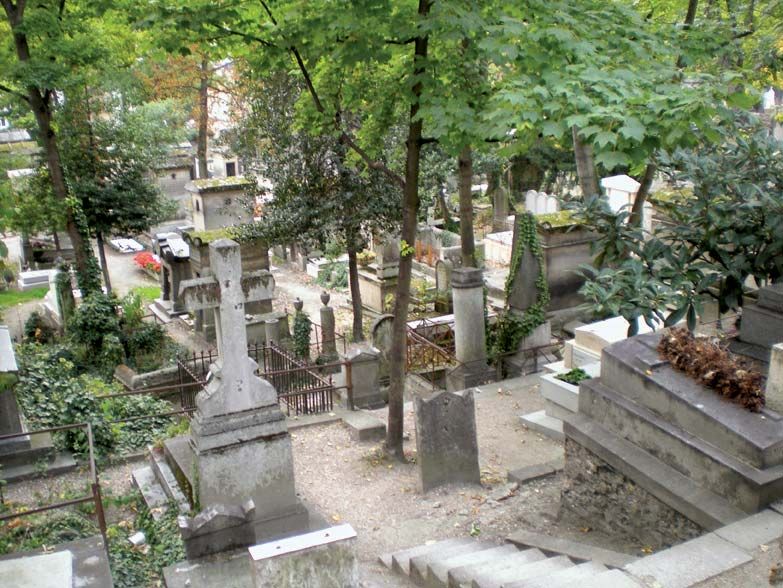
The inclusion of Père-Lachaise Cemetery is a given. It’s one of the most-visited cemeteries in the world. Setting aside for the moment all the luminaries buried there, we encourage you to begin your visit with a stroll on the grounds, with their wide cobbled walkways and beautiful shade trees. The pleasant parklike atmosphere of this burial ground is positively uplifting. After you’ve left your worries behind, you can begin a closer scrutiny, seeking out everyone from Guillaume Apollinaire to Oscar Wilde. Jim Morrison’s grave is there, as you may know, but you might prefer to visit Frédéric Chopin’s. Gertrude Stein’s gravestone can be discovered there, but you may wish to pay tribute to Molière and Colette too. You should not miss Jacob Epstein’s memorial to Wilde. You are certain to have your own homages to pay. In any case, it’s a glorious way to spend a few hours, or perhaps…longer.
Granary Burying Ground, Boston
Wondering which of the walking tours of Boston to take? You would do well to consider a meander off the beaten path, the Black Heritage Trail or the Boston Women’s Heritage Trail (on which, for example, you can find the location of Elizabeth Palmer Peabody’s West Street bookstore). Several tours take you past the remarkable Granary Burying Ground on Tremont Street. There you can stroll among 17th- and 18th-century markers. Sure, Sam Adams, Paul Revere, and John Hancock are buried there, but so are Crispus Attucks and Phillis Wheatley. How great is that? Certainly worth seeking out.
Isola di San Michele, Venice
It’s hard to say which aspect of this cemetery is coolest—the approach, its history, or its inhabitants. To get there, you have to be in Venice, one of the world’s best cities. You make your way to the vaporetto stop by walking down a street lined with the establishments of marble carvers—just to put you in the proper frame of mind. The boat ride to the island is short, though there’s time enough to let the formal feeling enter. Time enough too to thank Napoleon for decreeing that persons were no longer to be buried under the paving stones in Venice, that what became Isola di San Michele was to be dedicated to the dead. Much is to be seen on the island, and its restrained planning rewards the observant visitor. If your time is limited, however, avoid the formal grounds and the workers digging up those whose lease has expired (it’s still a working cemetery and can only hold so many). Make your way to the unkempt and picturesque Protestant and Russian Orthodox areas, which contain the remains of several great Modernists, notably the notorious Ezra Pound in the former and Serge Diaghilev and Igor Stravinsky in the latter.
St. Michael and All Angels Church Cemetery, Haworth, Yorkshire, England
Anyone who ranks Charlotte and Emily Brontë high in the pantheon of British writers should not miss a visit to the parsonage in Haworth. If you have a choice, it’s best to go there on a chill and blustery day, preferably one with a cold drizzle and no sun. The nearby cemetery is of a piece with the climate—bleak, pinched, crowded, forlorn, and fascinating. Although the Brontës are not buried there (most—all but Anne, who was buried at Scarborough—are in a vault inside the church), don’t miss it. Walk on to the moors, if your hands and face are not cold enough.
The trusted destination for professionals, college students, and lifelong learners.
SUBSCRIBE


Bonaventure Cemetery, near Savannah, Georgia
Bonaventure is another extremely picturesque place of rest. Make sure you have GPS, because it isn’t easy to get to. The persistent person is surely rewarded. The old-growth oaks trail Spanish moss, and an air of bittersweet melancholy hangs over the dusty grounds. The recommended time to visit, provided you are not staying, is early in the morning. Whether or not you’ve seen Midnight in the Garden of Good and Evil (1997), even if you have no desire to find the graves of Conrad Aiken and Johnny Mercer, the setting is both transformative and a photographer’s dream—from the sometimes elaborate wrought-iron fences around the plots in the older sections to the ghostly shadows on the ground.
Key West Cemetery, Key West, Florida
Key West has many and various attractions. You can find an Elizabeth Bishop house, the Ernest Hemingway Home and Museum, a house briefly lived in by John James Audubon, and a storefront apartment rented by Tennessee Williams, not to mention the Ripley’s Believe it or Not! Odditorium and, if you must, the ever-popular Margaritaville. The cemetery is also worth a visit. There you can find the epitaphs of hypochondriac B.P. Roberts (“I told you I was sick”), Minnie Elizabeth Otto (“Her life was a beautiful morning”), Gloria M. Russell (“I’m just resting my eyes”), and Edwina Lariz (“Devoted fan of singer Julio Iglesias”). Many of its “burials” are in aboveground vaults, the result of a particularly grotesque scene following an 1846 hurricane that wiped out the former cemetery and reportedly deposited partially decomposed bodies in trees. (They were reburied, of course. You don’t have to think about that while you’re there.) It’s a quirky cemetery for a quirky place.
Rosehill Cemetery, Chicago
Named for the rise of land on Hiram Roe’s farm, Rosehill is one of two great cemeteries in Chicago (the other is named Graceland). Rosehill makes the list above all for its spectacular monuments and its nuggets of Chicago history. Among the noteworthy monuments are the Egypt-themed tomb of railroad president Darius Miller and a Gothic vault across the way, as well as several unusual sculptures, including a stone sofa, a limestone tree with a railroad mail car at its base, and two greyhounds. The cemetery’s denizens include a U.S. vice president (Charles G. Dawes), two Illinois governors, and many mayors, congressmen, military men, and titans of industry—Montgomery Ward, Richard Sears, A.B. Dick, and Milton Florsheim (of Florsheim Shoes) among the latter. Robert (Bobby) Franks, murdered by Leopold and Loeb, is buried there, as are Woman’s Christian Temperance Union leader Frances E. Willard and Burr Tillstrom, the puppeteer who created the television program Kukla, Fran and Ollie. Stroll along its well-ordered avenues and you’ll have more than a few pleasant surprises.