English Civil Wars: Quick Facts
Facts
| Also Known As | Great Rebellion • Wars of the Three Kingdoms |
|---|---|
| Date | 1642 - 1651 |
| Location | United Kingdom • England |
Did You Know?
- Many of the King's supporters abandoned him after he worked to recruit foreign soldiers to his cause.
- The public was incensed by Charles' invasion of Parliament and armed demand for five of the MPs in 1642.
- Religion was one of the dividing factors in the war: conservative Protestants and Catholics sided with the King and Puritans sided with Parliament.
Photos and Videos





Related Topics and References
Dig Deeper: More Articles That Discuss This Topic
Timeline

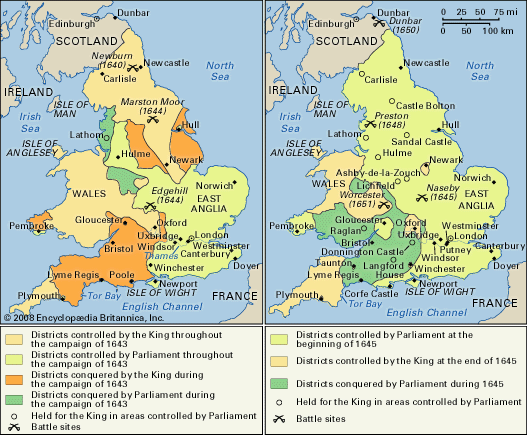
Battle of Edgehill
October 23, 1642

Battle of Marston Moor
July 2, 1644

Battle of Naseby
June 14, 1645
Battle of Dunbar
September 3, 1650
Key People
Henry Wilmot, 1st earl of Rochester
English noble

Oliver Cromwell
English statesman

Charles I
king of Great Britain and Ireland

Charles II
king of Great Britain and Ireland

John Pym
English statesman

Prince Rupert
English commander

Henry Ireton
British statesman

William Cavendish, 1st duke of Newcastle-upon-Tyne
English commander

John Lambert
English general

George Monck, 1st duke of Albemarle
British general

Thomas Fairfax, 3rd Baron Fairfax
English general

Robert Blake
British admiral

Henrietta Maria
queen consort of England
Alexander Leslie, 1st earl of Leven
Scottish army commander

James Graham, 5th Earl and 1st Marquess of Montrose
Scottish general

Archibald Campbell, 1st marquess and 8th earl of Argyll
Scottish politician [1607?–1661]

James Hamilton, 3rd marquess and 1st duke of Hamilton
Scottish Royalist
Robert Devereux, 3rd earl of Essex
English noble

Algernon Sidney
English politician
John Middleton, 1st earl of Middleton
Scottish Royalist