Crimean War: Quick Facts
Facts
| Date | October 4, 1853 - February 1, 1856 |
|---|---|
| Location | Crimean Peninsula • Ukraine |
| Participants | France • Ottoman Empire • Sardinia • United Kingdom • Russian Empire |
| Context | Russo-Turkish wars |
Did You Know?
- This was the first major war where civilian journalists and photographers such as William Howard Russell, Roger Fenton, and James Robertson were on the field sending information and photographs.
- The trench warfare that would become so prominent in WWI was employed at Sevastapol.
- Tolstoy's stark "Sevastopol Sketches" advanced his literary career; ten years later, he would write "War and Peace" based partially on his experiences in the Crimean War.
Photos




Related Topics and References
Topics
Dig Deeper: More Articles That Discuss This Topic
Timeline

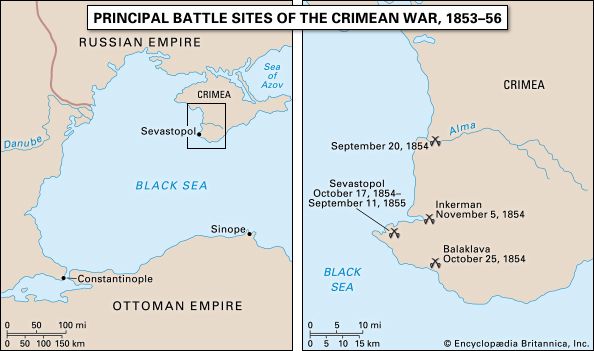
Battle of Alma
September 20, 1854

Siege of Sevastopol
October 17, 1854 - September 11, 1855

Charge of the Light Brigade
October 25, 1854
Battle of Balaklava
October 25, 1854
Key People

Napoleon III
emperor of France

Nicholas I
tsar of Russia

Lord Palmerston
prime minister of United Kingdom

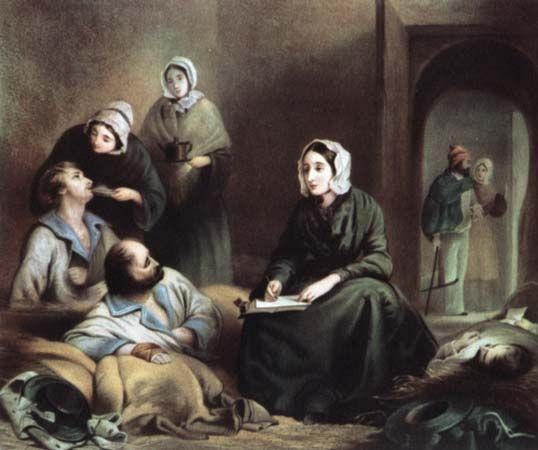
Florence Nightingale
British nurse, statistician, and social reformer

Karl Vasilyevich, Count Nesselrode
Russian foreign minister

Prince Mikhail Dmitriyevich Gorchakov
Russian statesman
Charles-Denis-Sauter Bourbaki
French general

George Hamilton-Gordon, 4th earl of Aberdeen
prime minister of United Kingdom

Aimable-Jean-Jacques Pélissier, duc de Malakoff
marshal of France

Mary Seacole
Jamaican nurse

Henry Hardinge, 1st Viscount Hardinge
governor general of India

George William Frederick Villiers, 4th earl of Clarendon
British statesman

Certain Canrobert
French soldier

Sir Charles Napier, Count Napier de São Vicente
British admiral

FitzRoy James Henry Somerset, 1st Baron Raglan
British field marshal

Fox Maule Ramsay, 11th earl of Dalhousie
British statesman

Armand-Jacques Leroy de Saint-Arnaud
French military officer
Adolphe Niel
French military officer
Aleksandr Sergeyevich, Prince Menshikov
Russian military commander
Causes and Effects
Causes
- A dispute between Russia and France over the privileges of the Orthodox and Roman Catholic churches in the holy places in Palestine
- Demands by Russia to exercise power over the Orthodox subjects of the Ottoman sultan
- The destruction of a Turkish squadron at the seaport of Sinope in the Black Sea by a Russian fleet, which brought British and French fleets into the area to protect Turkish transports and ultimately brought those two countries into the conflict
Effects
- Revolutionary new treatments of wounded soldiers spearheaded by British nurse Florence Nightingale that paved the way for later developments in battlefield medicine
- The deaths of over 500,000 people, a disproportionate number of which were caused by disease
- The loss of Russian support for Austria since the latter country had supported Great Britain and France in the conflict, which contributed to Austrian defeats in 1859 and 1866 that, in turn, led to the unification of Italy and of Germany
- The realization of new Russian emperor Alexander II that his country needed to overcome its backwardness in order to compete with other European countries, beginning a modernization movement there