
How did Archimedes use the law of the lever in mathematics?
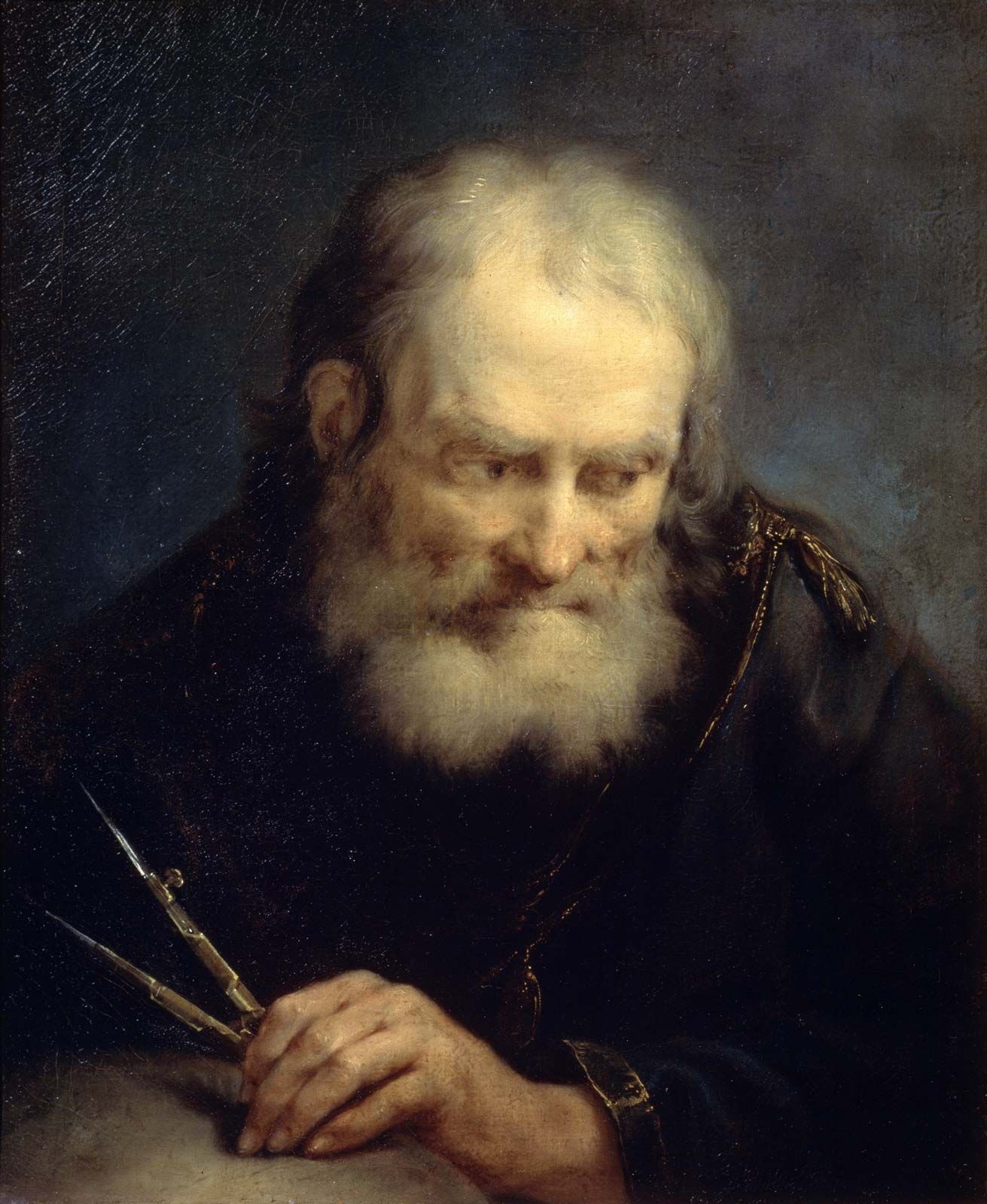
Archimedes utilized the law of the lever—which states that magnitudes balance at distances from a fulcrum in inverse ratio to their weights—as a heuristic tool to advance his mathematical discoveries.1
In his work Method Concerning Mechanical Theorems, he described a "mechanical" method where he divided geometric figures into an infinite number of infinitesimally thin strips. By conceptually "weighing" these corresponding strips against each other on a notional balance, he was able to determine the ratios of areas and volumes for complex shapes, such as the area of a parabolic segment or the volume of a sphere.1
While Archimedes used this mechanical approach to arrive at his results, he explicitly emphasized that it did not constitute a rigorous mathematical proof. For his formal publications, such as On the Sphere and Cylinder and Quadrature of the Parabola, he relied on the rigorous method of exhaustion to confirm the findings he had initially discovered through his mechanical reasoning.12