
How did Archimedes study centers of gravity?
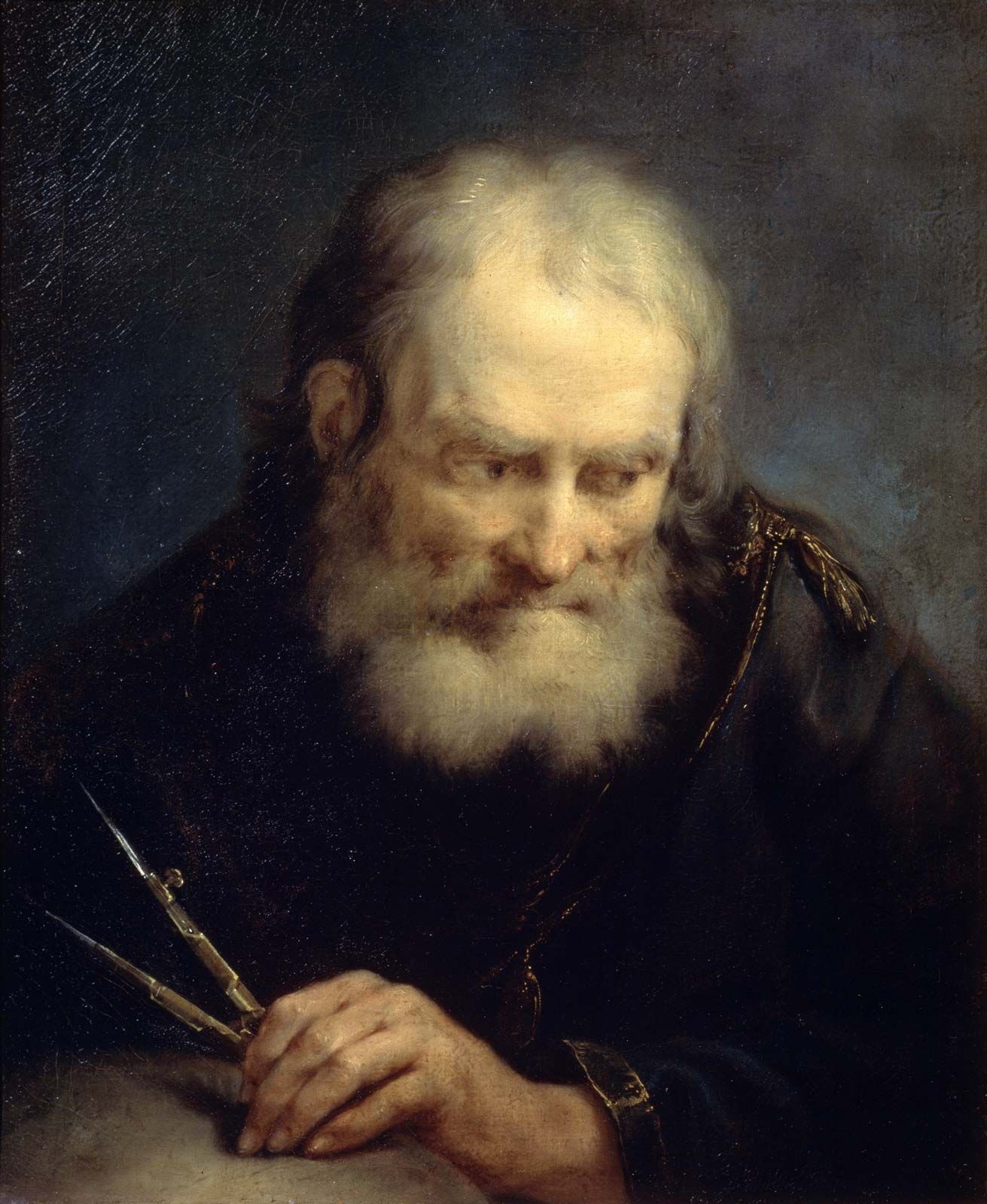
Archimedes studied centers of gravity primarily through his work On the Equilibrium of Planes (also known as Centres of Gravity of Planes), which established him as a foundational figure in theoretical mechanics.1
Rather than discovering the concept itself—which was likely established by earlier scholars—Archimedes is credited with extending the study of centers of gravity to include various rectilinear plane figures, as well as segments of the parabola and the paraboloid. His approach was deeply rooted in geometry and the "law of the lever," which posits that magnitudes balance at distances from a fulcrum in inverse ratio to their weights.1
Additionally, in his work Method Concerning Mechanical Theorems, Archimedes utilized a heuristic "mechanical" technique to explore mathematical properties. This involved dividing figures into an infinite number of infinitesimally thin strips and "weighing" corresponding pairs against each other on a notional balance to determine ratios. While this method served as a powerful tool for discovery, Archimedes maintained a commitment to rigorous proof, typically employing the geometric methods of successive finite approximation for his final results.1