
Britannica
Sources used in this answer
How did Archimedes calculate the surface area of a sphere?
Created from Britannica articles
using AI.
AI can make mistakes, so verify using Britannica articles.
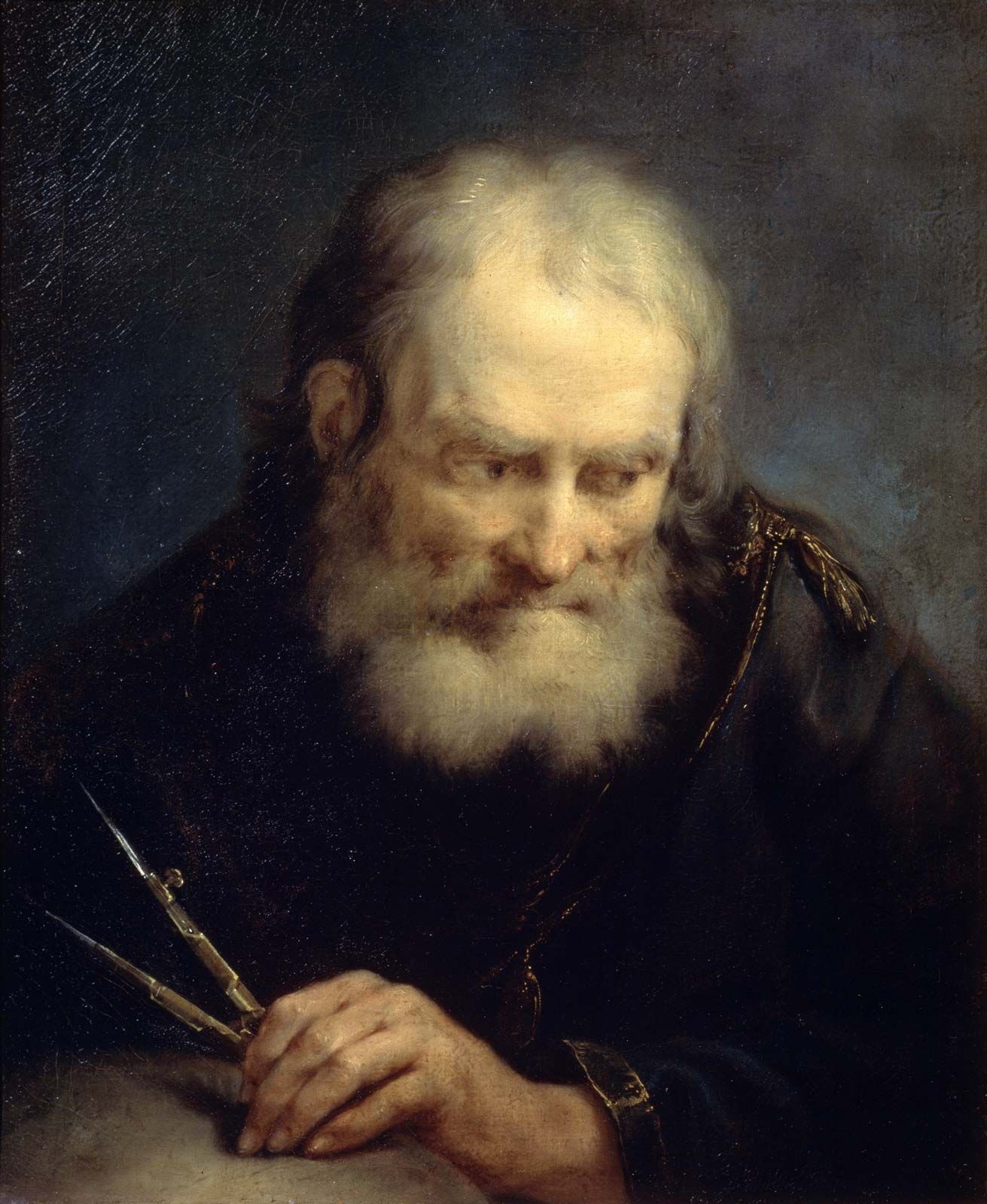
Archimedes
Archimedes, oil on canvas by Giuseppe Nogari, 18th century; in the Pushkin Fine Arts Museum, Moscow. Archimedes was an ancient Greek mathematician and inventor.
Archimedes determined that the surface area of a sphere with radius r is equal to four times the area of its greatest circle, expressed in modern notation as .123
He approached this discovery through two distinct methods:
- Heuristic Discovery: In his treatise Method Concerning Mechanical Theorems, Archimedes used a "mechanical" technique to arrive at the formula. He divided figures into an infinite number of infinitesimally thin strips and "weighed" them against each other on a notional balance using the law of the lever to determine their ratios.2
- Rigorous Proof: Because he recognized that mechanical reasoning was not a formal proof, he established the result in his work On the Sphere and Cylinder using the method of exhaustion. This rigorous approach, originally developed by Eudoxus of Cnidus, relied on successive finite approximations to confirm the geometric properties of the sphere.23
Archimedes was so proud of his findings regarding the sphere and its relationship to a circumscribing cylinder that he requested a diagram of this relationship be engraved on his tombstone.123