
- Related Topics:
- Crotalus

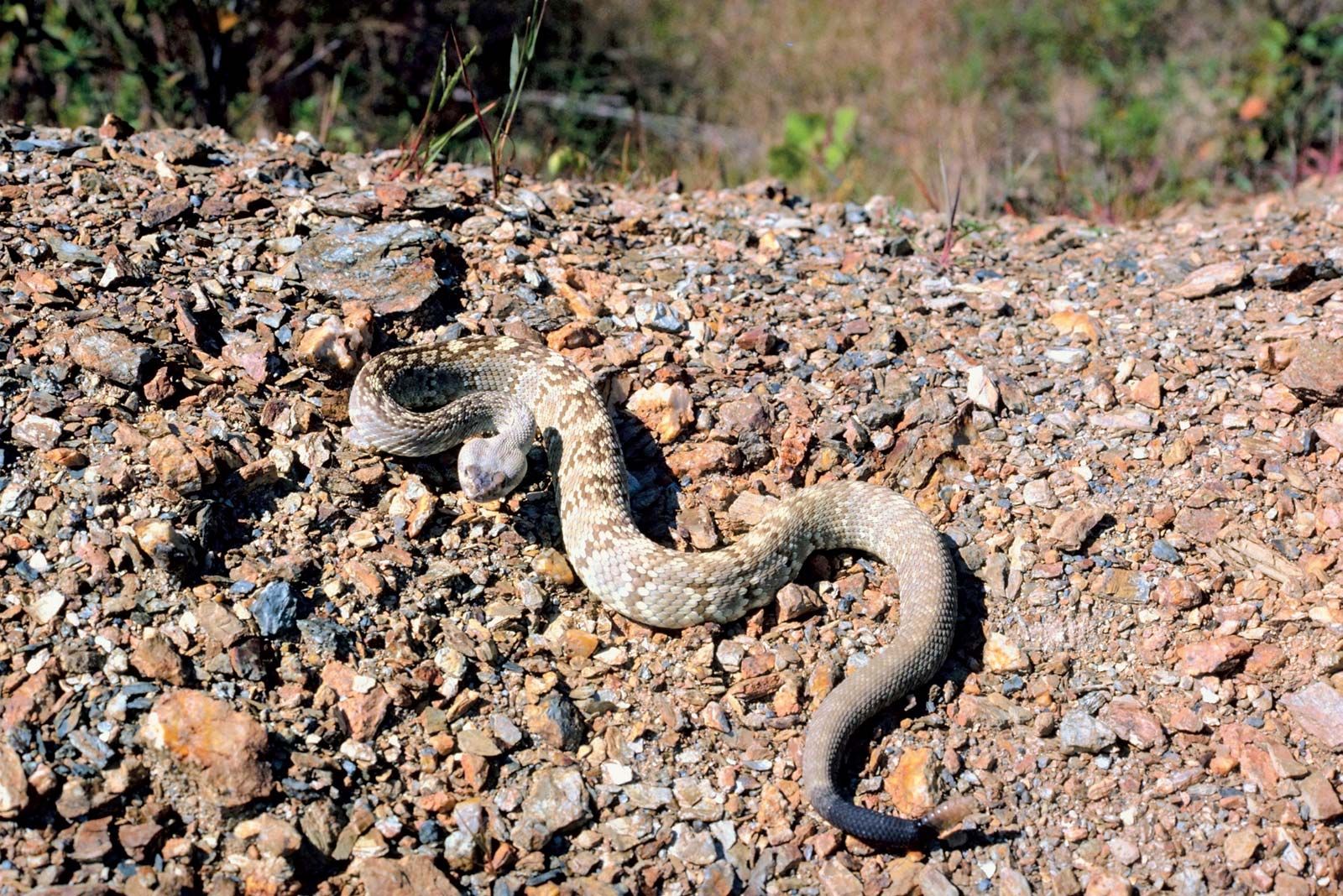
black-tailed rattlesnake
-
What is a black-tailed rattlesnake?
The black-tailed rattlesnake (Crotalus molossus) is a pit viper inhabiting rocky areas from Arizona to central Mexico and southwestern Texas. It has a calm temperament and is not considered one of the more dangerous rattlesnakes.
These snakes average roughly 3 feet in length, though some males can grow larger than 4 feet. They can be identified by their large triangular heads, stout bodies, and short black tails that end in a rattle. Their coloration is typically greenish-gray, gray, or yellow, with dark, irregular bands that sometimes widen into diamond-shaped blotches.
Black-tailed rattlesnakes hunt prey such as wood rats, rabbits, and squirrels, injecting hemotoxic venom with hollow fangs. They are active from spring to the first frost and hibernate in rock crevices during the winter.
4 Britannica SourcesCreated from Britannica articles using AI. AI can make mistakes, so verify using Britannica articles. -
Where do black-tailed rattlesnakes live?
The black-tailed rattlesnake (Crotalus molossus) is a pit viper inhabiting rocky outcrops, canyons, and cliffs in the mountain ranges from Arizona southward to central Mexico and eastward into southwestern Texas. They are active from early spring to the first frost, preying on wood rats, rabbits, and squirrels. In winter, they hibernate individually in rock crevices, emerging on warm days to bask on rocks.
3 Britannica SourcesCreated from Britannica articles using AI. AI can make mistakes, so verify using Britannica articles. -
What does a black-tailed rattlesnake look like?
The black-tailed rattlesnake (Crotalus molossus) is a stout pit viper inhabiting rocky areas from Arizona to Mexico and southwestern Texas. Adults average 3 feet in length, though some males can exceed 4 feet. They have a large, triangular head, a narrow neck, and a short black tail ending in a rattle.
Their coloration varies from greenish-gray to gray or yellow, featuring dark, irregular bands that sometimes widen into diamond-shaped blotches with yellow centers. The scales appear like beadwork, each being a single color. They have small, silvery eyes with vertical pupils and overhanging scales that create a scowling look. A pair of heat-sensing pits are located between their eyes and nostrils, which helps them to locate prey.
2 Britannica SourcesCreated from Britannica articles using AI. AI can make mistakes, so verify using Britannica articles. -
How does a black-tailed rattlesnake defend itself?
The black-tailed rattlesnake defends itself primarily by avoiding confrontation. When threatened, it will attempt to crawl away into undergrowth. If escape is not possible, the black-tailed rattlesnake will vibrate its tail rapidly, creating a buzzing sound to ward off potential predators. This buzzing is made possible by the rattle segments at the end of its tail. If these defensive measures fail, the snake will strike, injecting hemotoxic venom into its victim.
3 Britannica SourcesCreated from Britannica articles using AI. AI can make mistakes, so verify using Britannica articles. -
What do black-tailed rattlesnakes eat?
The black-tailed rattlesnake primarily eats wood rats, rabbits, and squirrels. It follows their scent trails and waits in concealment to strike. The snake injects hemotoxic venom into its prey, which affects the red blood cells, and then trails and consumes the dying creature. The black-tailed rattlesnake is active from early spring to the first frost.
2 Britannica SourcesCreated from Britannica articles using AI. AI can make mistakes, so verify using Britannica articles. -
How do black-tailed rattlesnakes help their ecosystems?
The black-tailed rattlesnake plays a role in its ecosystem by preying on rodents, rabbits, and squirrels. This helps to control rodent populations, which is a valuable service in maintaining the natural balance of desert ecosystems. At the same time, the snakes themselves become prey for birds of prey, mammals, and other reptiles, thus making them secondary consumers in the food chain.
However, rattlesnake roundups, where these snakes are collected and destroyed, may reduce their beneficial impact on the control of rodent pests.
4 Britannica SourcesCreated from Britannica articles using AI. AI can make mistakes, so verify using Britannica articles.
black-tailed rattlesnake, (Crotalus molossus), North American pit viper (subfamily Crotalinae, family Viperidae) inhabiting rocky outcrops, canyons, and cliffs in the mountain ranges of Arizona southward to central Mexico and eastward into southwestern Texas. Although the bite of a black-tailed rattlesnake is potentially lethal to humans, the snake has a relatively calm temperament and is not considered one of the more dangerous rattlesnakes.
The black-tailed rattlesnake has a large triangular head, a narrow neck, a stout body, and a short black tail ending in a rattle. Adult length averages 0.9 meter (3 feet), though older males may exceed 1.2 meters (4 feet) in length. Coloration is greenish gray, gray, or yellow, with a body pattern of dark irregular bands, some of which widen above into diamond-shaped blotches with yellow centers. The large scales resemble beadwork because every scale is of a single color. The silvery eyes are small, with vertical pupils and overhanging scales that give the appearance of a scowl. A pair of deep pits between the eyes and nostrils are heat-sensing organs that can detect any object whose temperature differs from that of the surrounding environment. These pit organs are a useful adaptation for locating prey.
Like those of other rattlesnakes, the hollow fang of the black-tailed rattlesnake is similar to a curved hypodermic needle. At the top it meets with the end of the venom duct. Soft tissue surrounds the end of the venom duct and the base of the fang, providing a seal against leakage. Large venom glands at the base of the jaws are responsible for the distinctly triangular shape of the head. When the snake’s mouth is closed, the fangs are folded back and lie parallel to the roof of the mouth. Linkages of bones in the upper jaw allow the fangs to be deployed into a vertical position for stabbing and biting. Fangs are periodically lost owing to wear and breakage. Each fang has a series of seven developing fangs behind the functional fang, each smaller and less developed than the one preceding it.


 " height="20" alt="HEW Logo">
The snake is active from early spring to the first frost. It follows the scent trail of its prey—mainly wood rats, rabbits, and squirrels—then waits in concealment. It springs out and strikes the passing prey with lightning speed, injecting its victim with hemotoxic venom that affects the red blood cells. The snake quickly releases the animal, waits a few minutes, then trails and consumes the dying creature. In winter black-tailed rattlesnakes hibernate individually in rock crevices, emerging on warm days to bask on rocks.
Mating takes place in the summer. Black-tailed rattlesnakes give birth to live young that develop from eggs retained inside the mother (ovoviviparous). Litters are born in the early fall. Females remain with their young for about a week, until their first skin is shed. Newborns resemble adults except for rings on the tail, which disappear as the young mature. Armed with functioning fangs and venom glands, newborns have venom that is more potent but of lesser quantity than that of their mother, a condition that helps ensure that the young can secure food. Babies are also equipped with a single button on the end of the tail, which gains a rattle segment after each shedding of the skin. Once the third rattle segment has been obtained, the young snake can buzz like an adult.